
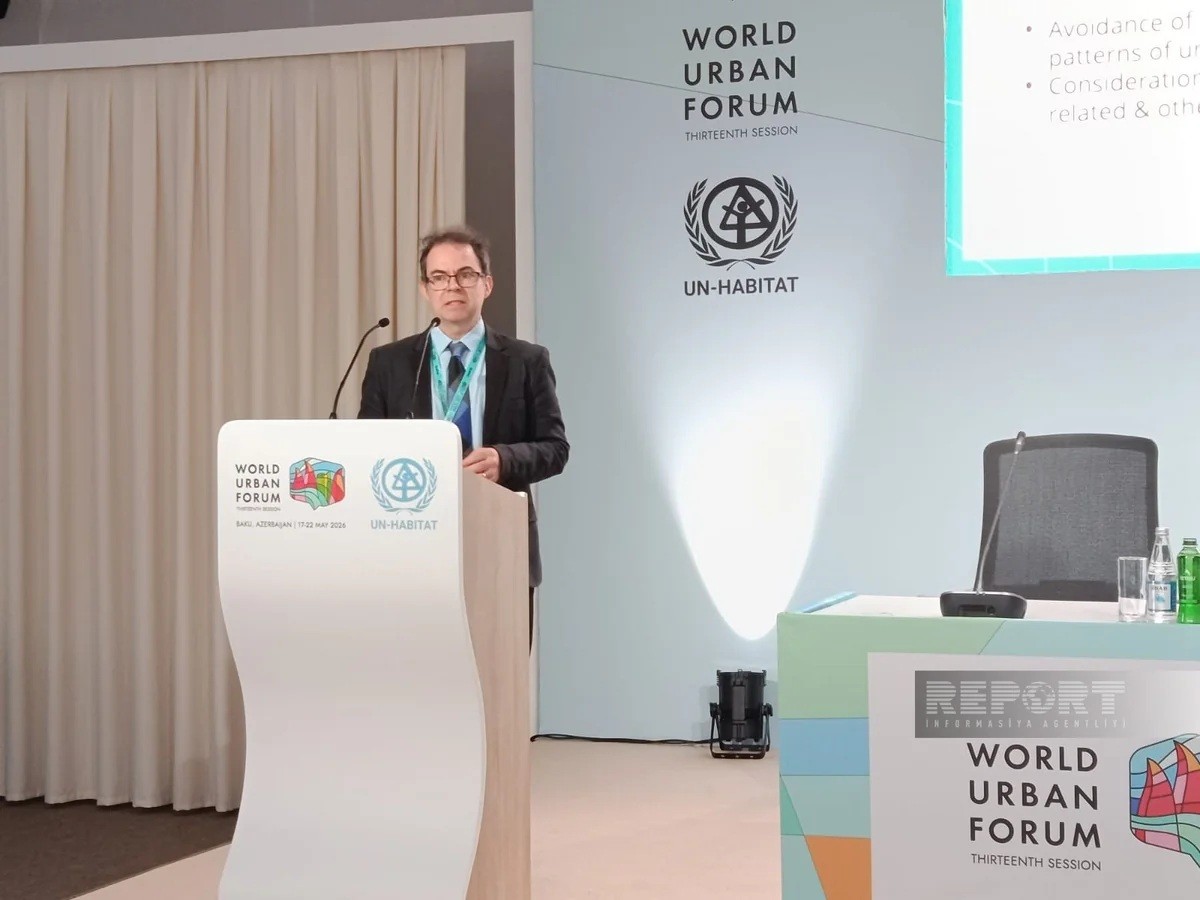
In recent decades, the volume of geospatial data has increased rapidly, said Mark Roberts, Lead Economist for Urban Development at the World Bank, during an event titled “Geospatial Intelligence for Sustainable Urban Growth: Unlocking the Economic Potential of Housing Construction” held within the 13th World Urban Forum (WUF13) in Baku, Report informs.
According to him, there has been significant growth in the quantity, quality (taking into account resolution), and coverage of available data: “Numerous global datasets are now available. At the World Bank, we use data obtained from other providers as well as data we generate independently. These include the Global Human Settlements Layer from the European Commission’s Joint Research Centre, as well as open‑source data such as OpenStreetMaps.”
Roberts noted that the World Bank studies how rapidly urban expansion is occurring and why it is happening in certain countries and regions: “This is important for policymakers for several reasons. First, it helps determine whether cities are growing efficiently in a way that aligns with productivity and environmental considerations. It distinguishes between compact economic growth models and more sprawling models that are associated with greater environmental degradation, a larger carbon footprint, and are less favourable for productivity and quality of life in cities. This is also very important from an urban governance perspective.”
https://report.az/en/infrastructure/world-bank-volume-of-geospatial-data-has-grown-rapidly